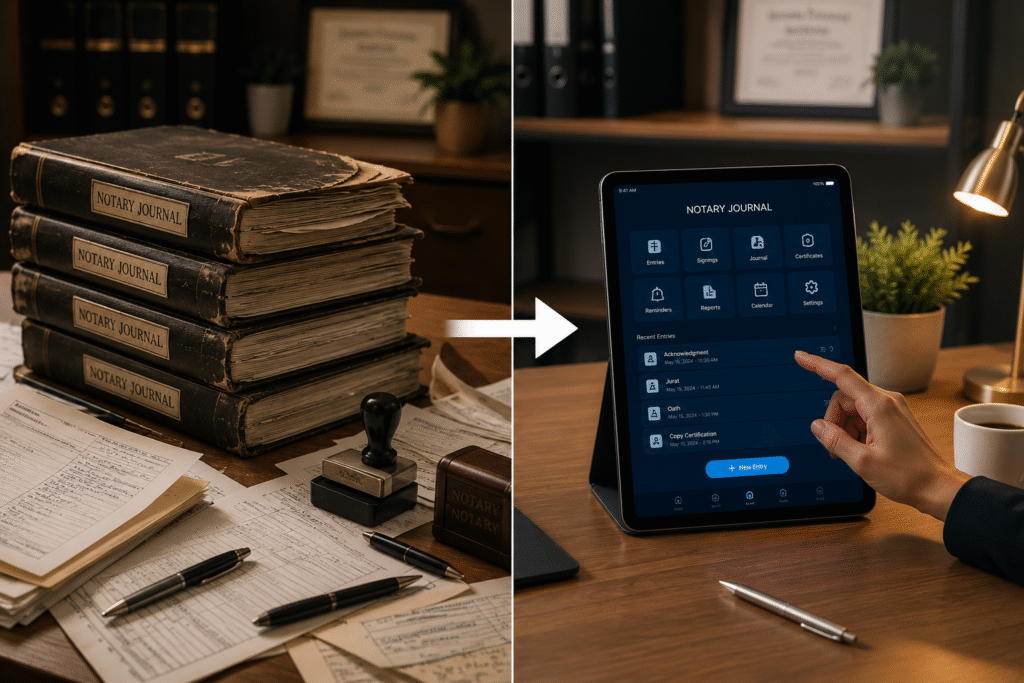
The fastest way to store notary records today is by using a digital notary journal designed for secure, mobile-friendly, and compliant record keeping. Many notaries searching for “fastest way to store notary records near me” are moving away from paper systems because handwritten entries are slow, difficult to organize, and vulnerable to loss or damage. A modern notary journal app simplifies notary record keeping through automation, secure storage, digital signatures, and instant mobile access. If you’ve wondered “is digital notary journal legal,” “how to keep notary records,” or compared paper vs digital notary journal systems, digital solutions are becoming the preferred option for notaries across the US.
Traditional paper journals often create problems during audits, high-volume signings, and mobile notarizations. Digital workflows help notaries save time, improve accuracy, and maintain audit-ready records without carrying bulky paperwork.
A notary journal is an official log used by Notary Publics to document notarization transactions. It typically includes:
Many states require proper notary record keeping to help protect against fraud and maintain compliance.
Accurate journals also support:
For more guidance, review the NJA Notary Journal Guide and compliance FAQ resources.
Paper journals require handwritten entries for every appointment, which slows down busy notaries. A digital notary journal automatically fills repetitive information, making appointments faster and more efficient.
Manual records often contain incomplete entries or handwriting mistakes. An electronic notary journal improves accuracy with guided workflows and automation.
Paper journals can easily be lost, damaged, or destroyed. Digital systems provide encrypted backups and secure cloud-based storage.
Finding old records inside paper journals takes time. A mobile-friendly notary journal app allows instant access to searchable records directly from your phone.
Paper systems commonly create:
Digital workflows help eliminate these issues.
Yes, a digital notary journal is legal in many US states when used according to local notary regulations.
However, laws vary by state. Some states fully allow electronic journals, while others may require additional procedures or retention standards.
Notaries should always verify:
When used properly, an electronic notary journal helps notaries maintain compliant, secure, and audit-ready records.
Visit the NJA FAQ page for state-specific compliance guidance.
Automation reduces repetitive writing and speeds up notarizations.
Auto-filled entries help reduce missing or inaccurate information.
Searchable digital records simplify audits and compliance reviews.
Mobile access allows notaries to securely manage records from anywhere.
Clients increasingly expect faster and more convenient digital experiences.
NJA supports ID verification, including foreign IDs, helping notaries confirm signer identity quickly.
The app automatically fills common journal details to reduce repetitive typing.
Signers can securely provide digital signatures directly inside the app.
Encrypted storage protects confidential information and secure notary records.
Records are available directly from your smartphone or device whenever needed.
Organized and searchable documentation simplifies audits and compliance reviews.
Notary Journal App includes modern features designed for real-world notary workflows:
These tools help notaries manage records faster while maintaining professionalism and compliance.
Automation significantly reduces time spent on paperwork.
Digital systems eliminate repetitive handwriting and filing.
Guided entries help reduce incomplete records and manual mistakes.
Encrypted storage helps protect confidential signer information.
Structured workflows support proper notary record requirements and compliance standards.
Manage notary records directly from your smartphone or tablet.
Paper journals can disappear or become damaged permanently. NJA securely stores records with backup protection.
Searching paper entries manually can be frustrating and time-consuming. Digital search tools simplify audits.
Handwritten records often contain mistakes. Automation improves consistency and accuracy.
Writing repetitive details slows down appointments. Auto-fill technology speeds up the process.
Paper systems quickly become difficult to manage. Digital organization keeps records structured and searchable.
A digital solution becomes especially valuable if you:
Many professionals switch after experiencing the limitations of paper systems during busy signing schedules.
Your notary journal helps protect your business, records, and professional reputation.
The right platform should provide:
Choosing a trusted notary journal app helps simplify workflows while protecting sensitive records.
For notaries searching for the fastest and most efficient way to manage records, a digital notary journal offers major advantages over traditional paper systems. Digital workflows improve efficiency, strengthen security, simplify audits, and eliminate paper clutter.
Notary Journal App helps notaries modernize record keeping with automated entries, secure storage, digital signatures, mobile access, and audit-ready organization all designed for real-world notary work.
Whether you’re a mobile notary, remote online notary, or high-volume signing professional, NJA provides the smartest way to manage notary records securely and efficiently.
Download the app today and start digital journaling with confidence.
The fastest way to store notary records is by using a digital notary journal with auto-fill entries, secure storage, mobile access, and audit-ready organization.
Yes, many US states allow digital or electronic notary journals when used according to state-specific notary laws and compliance requirements.
Notaries switch to digital systems because they save time, reduce manual errors, improve security, simplify audits, and eliminate paper clutter.